

25th April, 2026
Speaking to artist Graeme Baxter at his 160‑acre ranch in Texas, you get the sense that, when reflecting on his career, he can still hardly believe his luck. At the time, he’s working on an exotic new commission – Hualālai Golf Course in Hawaii – his 350th painting of a famous golf course. He’s averaged just under 10 paintings every year for the past 36 years, including 64 of the world’s 100 top golf courses. Later this year, he’ll paint Crystal Downs Country Club in Michigan and Rock Creek Cattle Company in Montana (taking his tally to 66), and presumably a handful of others to boot.
“They say ‘find a job you love and you’ll never work a day in your life,’” Graeme says, cheerfully (and probably not for the first time). “Well, I can attest to that.”
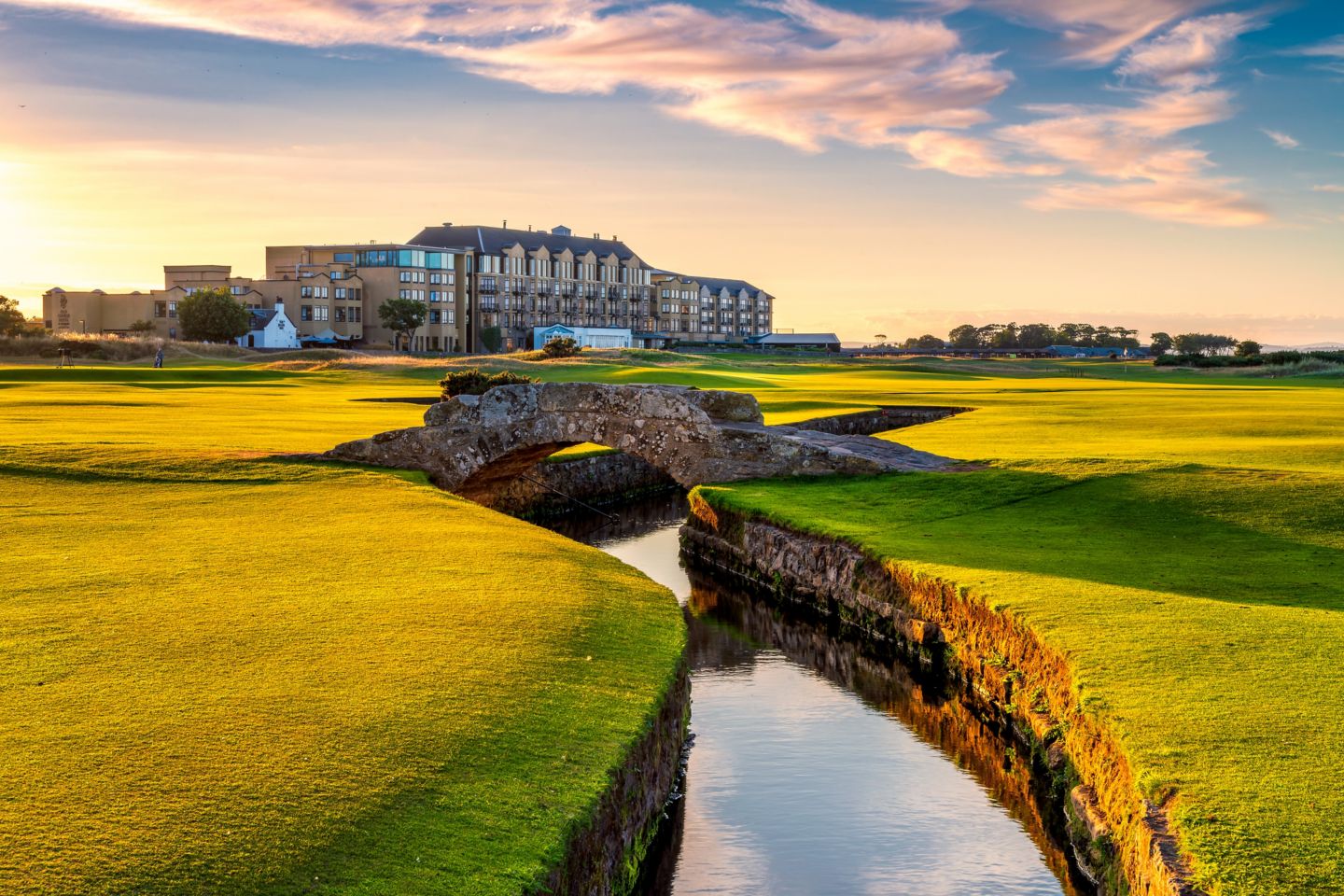
In 1986, the Scotsman combined his two greatest passions – golf and art – by painting a picture of the Old Course. At the time, his father, who owned an art gallery in Strathblane in Stirlingshire, asked innocently enough, “What is a painting of a golf course?” To which he replied, “I don’t know. I’m just going to paint the 17th hole, because I love the view of St Andrews.”
Suitably impressed, his father showed the work to Sir Michael Bonallack, then secretary of the Royal and Ancient Golf Club, who remarked that it was one of the finest golf paintings he had ever seen. They agreed to make 850 giclée prints – a lot for an unknown artist – which flew off the shelves. Graeme then decided to paint the clubhouse at Turnberry, which went down just as well.
“Apart from me, there was really only another American lady [Linda Hartough] painting golf courses at that time,” he recalls. “So between us, we painted all of the major tournaments for about the next 10 years.” Indeed, Graeme has been the official artist at The Ryder Cup, The Open Championship, The Presidents Cup, Solheim Cup, the PGA Tour and European Tour. His work is displayed in the clubhouses at Augusta, Pebble Beach, Mission Hills and Pine Valley in China – not to mention in the entrance of the Old Course Hotel.
“That is very much my masterpiece,” he says of the monumental painting hanging behind the concierge’s desk. It’s a snapshot of The Open in St Andrews in 2000, taken from the roof of the Old Course Hotel, and which took him six months to complete. “I said at the time that I was going to be the first living British traditional artist to sell a painting for over six figures, and thanks to the late Yoshiaki Sakurai [former chairman of The Kosaido Company, which owned the Old Course Hotel until 2004] who bought it at auction, that prediction came true.”
Plenty of conjecture surrounds the painting, as our concierge will tell you, but it does contain one or two easter eggs. “That’s my mum and dad above the 17th green,” grins Graeme. “My mum’s got a grey coat on and my dad’s wearing a 1991 Ryder Cup jacket, which he wore all the time. My wife [fellow artist Lorna Baxter] painted the dog on the path next to the first fairway.”
By the artist’s reckoning, he’s probably painted the Old Course 25 times. His interpretation of Swilcan Bridge is another of his most celebrated works. For him, the goal is to, “record golf history through my paintings. I like to be accurate but not photographically accurate. I’m striving to find the heart of a golf course – and this might sound a wee bit weird, but I feel I generally get to within feet of it. From there, I try to grasp the many details and colours, and capture its key characteristics and natural feel.”
How does he locate the heart of a course? “A lot of clubs tell me they’d like to look at holes number seven, nine and 18,” says Graeme. “I’ll photograph these, but also a few others that I’m drawn towards, and give them a shortlist of six. A lot of clubs have signature holes, but oftentimes, as Jack Nicklaus once said, ‘All my holes are signature holes.’ In which case, it’s about finding new angles that perhaps people haven’t seen before.”
Reflecting on his career, which he believes is far from over, Graeme says he could never have imagined meeting the likes of Arnold Palmer, Gary Player and Tiger Woods – let alone playing with some of them. “For me, there’s nothing better than getting in a golf cart, early in the morning or late in the evening when no one’s around, and driving round the course, taking it all in. And I’ve no intention of stopping. In fact, I’d like to think that one of these days I’ll fall over with a paint brush in my hand.”